Wednesday, February 26, 2020

YQ Wrap-up

The Yukon Quest had a tough year. Of the original fifteen entrants for the main race, it gradually tapered off to eleven. Some well-regarded mushers scratched out for a variety of reasons, mostly weather conditions which took a toll on dogs as well as the mushers. I was sorry that Jason Campeau had a bad 'wreck' in which several dogs were hurt as he came off Eagle Summit and hit some bad ice. He sat out a year to recover from a near-fatal concussion issue in 2018 and had really struggled to get back up to speed for this race. He will be back again I am sure and said ias much in his comments afterwards.

Besides this ice on the steep down slopes early in the race, there were blizzard snow conditions and later some major overflow problems that challenged everyone. However, I am really proud that the four women who had signed up completed the race, all but one in the top ten--which is kind of a feeble joke since only eleven finished! However they all did awesome jobs, even Olivia Shank-Webster-Neff who won the Red Lantern, arriving just at the start of the finisher's banquet on Feb 15. She had fought a real campaign holding last place for almost the whole thousand miles and braving deep blown snow and some fierce overflow as she made he final distance from Pelly to Whitehorse. She got a standing ovation from the crowd as she  came into the hall after settling her dogs.

The big competition for me was the two who led much of the race, double winner in a prior race and last year, Brent Sass and Michelle Phillips of Tagish Lake Kennel. They were running different schedules and played leap frog over and over as they passed each other while one had a team resting. Finally the last stretch seemed to be more manageable by Brent's very strong and tough team and he got and held the lead. Michelle and her team came in not too far behind--a couple of hours as I recall. Then there was a l-o-n-g gap before the third and fourth place racers arrived, Cody Strath of Squid Acres at third and Allen Moore of SPK as fourth. Another gap and Torston  Kohnert, a Swedish musher came in 5th and Ryne Olsen, once a protegee of SPK and now building up her own kennel was 6th. The other woman, Nora Sjalin, another Swede, got seventh place and rookie of the year.

I was very proud of all the women and enjoyed the speeches they made as they accepted their trophies. Michelle had run a very fine race and to be a close second under the savage conditions was a real win in every way. I was also impressed by Nora, whose command of English was very good and they all had wonderful things to say about their teams. It often seems to me that although all the mushers have a good bond with their dogs--it is really essential--that the women are at least more expressive about it and openly emotional with and about their canine partners. Well, maybe it is just a 'female' thing!

The jolt of the night came when Allen Moore admitted he had only been training for thirty days before this race after undergoing shoulder surgery in the summer. He announced this was his last big race and he was not going to fully retire but would be a handler for his daughter Bridgit who is following in his and step-mom Aliy's runner tracks and will be competing in the 2021 season. That brought a few tears as Allen is one of my mushing heroes but I know he will be part of Aliy's team as long as she is competing and now his daughter and maybe some grandkids will be coming along in the tradition. He is such a neat guy. I love his droll Arkansas humor and his upbeat attitude. In that he is very like Aliy but just lower key and the old country boy comes through in all the little jokes and homey phrases. He needs to write a book and I'd be honored to  help him on that!

A few pix I grabbed on line. The musher's banquet; that is Olivia getting a hug with her Red Lantern.
The next is Allen with the Black Team at the finish--he said the dogs were awesome! Only two 1000 mile 'rookies' were dropped, Decaf and Sanka, for minor injuries only.  Third is Michelle as she gave her speech. She is right up there with Aliy and Deedee as my most revered lady mushers! Her dog care is amazing. BTW, Cody got the Vet's award.


What the "L" is Qrill?

In the last two years a new word has made its appearance in the international mushing scene. I've been simply watching and listening but decided to share a bit of what I have discovered so far since this blog is all about the sled dog racing world and the folks involved in it, most especially the feminine.

First off, many of us have hard of Krill Oil being touted as a wonderful health panacea for humans. Krill is a tiny shrimp-type  crustacean found in bitter cold waters. mainly around the antarctic. I admit to taking  daily capsule of krill oil myself; I get it from Wallyworld which is probably not the best source for a quality product but that is not germain here.  Well, as in  many cases, what is good for us hoomans is also good for our critters, especially the more carnoivorous ones. With that in mind a Norwegian company has begun to produce and market pet food based on krill. What do they call it? Qrill! The logo features orange and their marketing and PR efforts are getting pretty spectacular.

A closely linked enterprise is their sponsorship of  first one and now several racing dog sled teams in an effort to promote the value of their special feed and to support, sustain and educate the public about the sport of mushing. You may recognize a few of the names and the rest will likely become more familiar soon. Here is the URL to the team page: https://www.qrillpet.com/theqrillpetteam

Thomas Waerner is a Norwegian musher who has competed in the Iditarod in the past and though not winning turned in a good performance. Then a few years ago, a younger countryman by the name of Joar Leifseth Ulsom appeared. To date he has run the Iditarod seven times, was rookie of the year his first try and has finished above tenth in each run, peaking as the winner in 2018. That year like last, he featured a lot of orange and carried the Qrill logo on his truck and some of the other gear. He was a close second last year to the 2019 winner, Pete Keiser, who so far is not involved in the Qrill enterprise. Joar currently resides in Alaska in the Willows area, north of Wasilla.

A name even the more casual mushing fans will recognize is Dallas Seavey. Scion of the old and well known mushing Seavey family--both his grandfather Dan and dad Mitch are I'rod winners--Dallas was the youngest competitor to run the big one on his rookie year at age 18. Since then he has scooped up for wins plus one win of the Yukon Quest. He got crosswise with the Iditarod board in 2017 about a badly botched and mishandled issue where two of his dogs post-race tested positive for tramadol, a synthetic opiate, and has not run that race since. Instead he migrated to Norway and started racing there. So far I do not think he has won the two big Norwegian races but he's doing well..

A couple of Norwegian ladies are also part of the team, Marit Beale Kasin and Hanna Lyrek. I am sure we will be hearing more of them in the future In short, keep your eyes pealed for orange dog trucks, parkas, sled bags and other gear that certainly seems will soon be ubiquitous on the major international competitions. The orange hexagon and slanted tear drop shape of their logos are already flashing in many places.

The latest project this very ambitious and energetic crew has taken on is a "world championship of sled dog racing" which for now involves mushers earning points in four major races--two in Europe--Russia and Norway-- the John Beargrease in the lower US 48 and the Iditarod.  One musher/team will grab the most points--winning the Iditarod is the highest valued placement--and will be declared the world champion.

On this in particular I do have mixed feelings. First there are far too few races to claim this level of a title. The Yukon Quest is not included and a number of major mid distance  and stage races in Alaska, Canada and the lower 48 states to say nothing of several long-running events in Europe are not factored in. And sprint racing is totally ignored. IMHO much more inclusion needs to happen before any grandiose titles are awarded. The point system seems pretty complex and even confusing although I have not really read the who schedule and rules on this yet; not sure where to even find them! Back to the search engines...

As an alternative I suggested a final race among only the winners of at least six to ten of the most onerous and long distance races competing in a race to be held at a revolving location of one of those big races after the main season is over or early the next winter if the venues lack sufficient snow. I admit this would be a logistical nightmare due to the complex requirements most countries have for bringing animals across their borders plus assembling a vet team, volunteers and all the needed facilities for the whole entourage and the reporters likely to follow. But if it could be accomplished, what a PR event that would be! I visualize a jewel studded "platinum"harness set for the lead dog or pair of the winner, a fancy belt or badge or helmet for the musher and great hoopla!! Well, one can dream. I was not exactly pooh-poohed off the page on the FB groups where I posted it but did get a dash of ice water on the difficulties involved!! For now I am in a wait-n-see mode on the Qrill World Championship Musher project but will follow developments closely and certainly watch the orange decked teams as they compete in the 2020 races and into the future. There were none in the YQ , Kusko300, CB300 etc. since they are not "sanctioned' by this new enterprise!

Tuesday, February 4, 2020

The Yukon Quest(s) Now Underway

Both the 1000 and the 300  mile versions of this race began Saturday, this year starting in Fairbanks, Alaska. Although a number of other races, several in the lower 48, were either starting or in progress, most of my readers here know my heart is in the Big Ones and those mushers. Of course those mushers also run in some of the mid-distance for many reasons. First, it is good training for dogs especially when they are bringing new young dogs into their teams. They may not run their top flight dogs--it all depends.   Another is a chance at some decent prize purses which help with the very expensive business of maintaining a kennel and keeping 20 to 50 dogs healthy, fed, doctored and fitted with harness and other equipment to say nothing of what the musher requires in cold weather gear and other supplies.  Serious sled dog racing is a bottomless money pit. Nobody is going to be doing it unless they love it fiercely and cannot envision a life this activity is not central to.

The fields in both the YQ races were small this season.There are a lot of reasons and issues behind this. Two young mushers who had signed up for the 1000 did not complete a needed qualifier when they scratched from the CB300. It was too late for them to change and run in the YQ300. There was some controversy over whether this was a fair and right decision but it stood. Then Matt Failor who had been running mid-distance races--no need to qualify for him since he has many races under his dogs' harnesses--also decided to try to pull out of the 1000 and run the 300 and again was not allowed. So in effect this actually reduced the contestants in both by three mushers. That left the fields at roughly fifteen for each race. That is enough competition to make each one a real race but it does reduce the purses some and probably gives PeTA and HSUS more ammo to twist and spin for their propaganda.

Anyway, as I write the 300 is nearing the close. At last count some nine or ten musher teams were in. Dave Turner won with Jeremy Traska close behind him. Madeline Rubida, a protegee of Tagish Lake Kennel, the home of Michelle Phillips and Ed Hopkins, got  third and Karolyn Bristol, working with and sponsored by SPK is shown on the tracker as 7th and Misha Wiljes as 8th. Misha ran the 1000 last year but lost a dog to aspirational pneumonia and perhaps did not think her team was up for the longer run. Three more are 'there' but not officially marked finish yet. The red lantern is either Leigh Strehlau or Deke Naaktgrboren. I had seen he had scratched but the tracker is not showing that yet. Two other racers did scratch earlier. Anyway it is virtually over and all remaining is the awards banquet which if memory serves is run in conjunction with the 1000 finish festivities, at Whitehorse this time.

So on to the big one. The leading group is at or out of Eagle Creek. Brent Sass is setting a scorching pace--I think he is really hungry for a third win. Giving him a run for his money is Michelle Phillips. She's run this race several times and it would be very neat to see her win. She'd be only the second female musher to do it. Aliy Z won in 2000, fairly early in her career.  Cody Strath, Torston  Kohnert and Allen Moore along with Ryne Olsen are hardly a safe distance back but not out of Eagle Creek per the tracker. That puts this group roughly a third of the way to the finish line. For now it is still a wide open race with a chance of a spoiler or two moving up though that gets less likely with each hour. Even at fast dog speed, twenty miles is a long way.

Two mushers scratched earlier today, and I am sad for them both.  Dennis Tremblay and Jason Campeau stopped for their teams welfare, they said. Of course that is the normal response but generally is is for real unless a musher is badly hurt or equipment too trashed to fix. Not much had been said but it appears the trail is pretty rough, icy, heavy snow, bare rock and all the extremes in various sections, rough on dogs, mushers and gear. Jason suffered a life threatening concussion two years ago and had worked and struggled for months to make a comeback so I feel especially sad for him. I hope he will have another chance in the coming years.

Bringing up the Red Lantern rear is Olivia Webster, actually Olivia Shank Webster Neff. I admit to mixed feelings about her. Her grandfather was almost the analog of Joe Redington as for as the Quest goes and naturally she wants to honor him. She tried last year and made it to Dawson (going west then) but with  controversial issues and problems. She ended scratching in lieu of being literally withdrawn by the judges. It was a messy situation and since I was not there and only heard different sides of the story which might all have been miles off the truth, I can't take sides. I do know her husband, Hugh Neff, is a very controversial figure and has been banned for alleged dog abuse and other issues. Again, what is fact versus rumor is hard to separate. I assume he is handling for her this time but do not know that for a fact.

I suspect she will scratch again but she is out of Slavin Gulch and still lugging along.  Just ahead of her are Dave Dalton and Pat Noddin. Dalton's name is familiar but not the other; not even sure if it is a guy or a gal as the name could be either. Need to go check the musher bios. They seem to be at a stop and she is less than ten miles behind them.

So the sled dog train is heading for Dalton and the 36 hour layover. Aliy is on her way there, handling for Allen as she usually does for the second half of the race. She kept tabs on Karolyn until the younger woman was heading for the last lap of the 300 but then did go on up to see Allen and the Black Team at the last checkpoint the road can reach. I bet she is in full mama mode this time not being distracted by running herself! She and Allen are very supportive and even protective of each other. I like that!I think Michelle and Ed are too and I know that fits Paige and Cody. Really admire these couples who are in it together and apply the musher teamwork to the max, even when they sometimes may compete. That is not usual although they may run a race together just to do it as Paige and Cody did the YQ a few seasons back.  Often one will run the A team while the other uses the puppy team in a learning role. Or they take turns running the two big races, one to each a year.

So now we follow the tracker and listen to the gossip and wait to see what happens next. Yep, it is still a dog race and **anything** can happen!! I reckon Lance knew that if anyone does!

Sunday, January 26, 2020

The John Beargrease Marathon


The John Beargrease ‘marathon’ is one of the older and better known mushing races in the lower 48.  It’s been an annual event since 1980 which means it is just a bit younger than the iconic Iditarod (first run in 1973).  The famous—or maybe infamous!—Yukon Quest is actually younger, first run in 1984.  There are actually three races, the main “marathon” close to 300 miles, a 120 miler and a 40 miler, run in one day. The big one is a qualifier for the Iditarod and many names well known in Alaskan racing circles do come down to participate in this notable event and others use the Beargrease to prep or qualify for their rookie run at the Iditarod. .

The race honors John Beargrease, a Native American of the  Anishinaabe tribe although also said to be of the Ojiba and the Chippawa tribes. This needs more research to unravel which I will attempt shortly. At any rate, he was born in 1858 and became a mail carrier, using a boat and dog sled to make his deliveries. Thus a sled dog race in his honor is a very logical and appropriate event. That this race is now part of the developing "world series of mushing," is one indication of how significant and how well regarded it is.

This year, the race started on the 26th of January—today as I write this—and will finish probably late Tuesday.  It is being tracked with regular updates at checkpoints and there is plenty of coverage if one knows where to look. I am delighted to see more and more of the mid-distance races are being given national coverage, active video recording and gathering a world-wide following that uses every bit of modern technology to further their fandom. 

A relatively small cohort of mushers and their fourteen dog teams took to the trail, just fourteen. However, several names would be familiar to folks who have mainly followed only Alaskan or in the case of the Quest, Alaskan/Canadian races.   Here is the complete list and bios on all this year’s competitors. https://beargrease.com/meet-the-mushers/  It is pretty 'wow' and even the 120 mile race includes many recognizable names. 

As for  me I am rooting for the women, of course, especially Jennifer Freking, Laura Neese, J. Foucher—a Facebook friend, and then Ryan Redington.  We’ll see who crosses the finish line first Tuesday evening and may the best team win!!

This time of year there is a race or even two just about every weekend and you can be busy indeed if you try to keep up with all of them.  I do--and also don't--quite. I have my favorites, both races and mushers, and check to see who is racing where and focus on them while giving others a more cursory watch. Fortunately I have a number of Facebook friends and others who are happy to share our mutual passion so I can almost always find out quickly what is going on everywhere dogs are tracking the snow.  Mush on!!

Monday, January 20, 2020

Kuskokwim 300 2020

As one of my heroes, Lance Mackey, so famously said, "It's a dog race, anything can happen." In this year's Kusko, this past weekend, that certainly applied!!

The Kusko--actually three races, the Akiak Dash, the 150 miler and the 300 miler--is often very cold and blizzardy being closer to the coast and incoming weather events. This year the CB300 was worse, though it is seldom balmy either. The Kusko had been postponed a couple of weeks due to weather but this time i was all right.

Anyway, twenty one mushers made the race. There were no scratches which is kind of rare, really. Two women entered and finished, Paige Drobney and Joanna Jagow. Both were rookies on this near legendary race and both ran well, finishing in the 13th and 14th places, coming in almost together. Two other mushers came directly from the CB300 to the Kusko, the winner and second place finisher from the former, Nic Petit and Matt Failer. Their results here were very different.

Matt admittedly used most if not all different dogs and I think that helped him to finish second, close behind Pete Kaiser, who won this one, his fifth win in the Kusko! Matt won this one last year but Pete is the reigning Iditarod Champ and one heck of a dog man.  It runs on the family. His father has won the Kusko and this year managed a very close second in the K150. It was almost a family affair in the winner's box!

Nic, however, was well back in the pack,. So, if you will entertain an armchair musher's thoughts, I will share a question and concern. I've not yet found whether Nic raced a new team in the Kusko or not but I suspect some if not all his dogs had just run the CB300 in some harsh cold and difficult conditions. It sounded that way as he flew them all right on over to Bethel. Were they not quite up to par? We  may never know. I am a booster of Nic's but have to allow that he does err in judgment at times and maybe push too hard. I do not question his love for and care of his dogs but like some doting parents may overdo his enthusiasm to see them excel. I hope they now rest well before taking on the I'rod come March. Not sure what his schedule is except the YQ races are not on it at last reading.

A cute little aside, as Matt F finished his check in at the finish, he approached partner and handler Liz Raines, pulled a small box out of a parka pocket and opened it to reveal a diamond flash! She is either a great actress or was truly surprised, almost blown away. Hand to her face she nodded and stammered her acceptance! That was a sweet bit of business and I am sure most watchers were thrilled. Who can resist a good romance and happy ending event? Surely not me!!

The next weekend's big race is the John Beargrease, one of the staged type I believe, and one of the few well known, long running major races in the Lower 48. There are always some Alaska mushers and it usually gets quite a bit of coverage. I'm sure there will be video and tracking. Maybe I can get links for that before the start.

One last note on the Kusko. Lance Mackey and Jeff King were entered as was Iditarod tradition Jim Lanier with his Siberians. Jeff finished along with Nic and a few others in the mid-pack. Jim  I think was 3rd from last and guess who got his first Red Lantern!! Lance did not push; perhaps he had that in mind all along. He is so quirky, it is possible! He'd never won the Kusko; nor had Jim but Jeff has about ten times, all some years in the past. Anyway I will try to catch the video of the awards tonight and see what Lance says. I expect I will both laugh and tear up. That is one absolutely amazing guy!

I share one photo--not mine--to illustrate. Joanne Potts had been the secretary and virtual soul of the Iditarod Headquarters for many years. The new officers abolished her position this past year. Many mushers and fans protested but without success. Before the planned celebration in her honor was finalized, her husband passed away. She insisted since a lot of work had been involved that her 'going away party' continue and it did. One in attendance was Lance and this touching shot portrays his sympathy and caring as he spoke to her. Joanne was "Mom" to so many in the Iditarod community; she is sorely missed and her treatment left a bad taste with many. Sadly it seems kind of in character for the new team; I withhold judgment but am inclined to feel very negative about the future under their direction.
Lance and Joanne Potts

A final addition, 21 Jan 2020: Nic did use the same dogs and in his recap he pretty well admitted that might not have been a good decision. I really do respect the guy and will continue to root for him but at times his willpower and enthusiasm does override good judgement. BTW it was Jim Lanier that he worked with and apprenticed under several years ago. Jim was the oldest K300 finisher ever --his speech as he took his 19th place award--and Lance had little to say as he took his red lantern but he was smiling and said it was his first ever--deliberate for sure. Last, Joanna Jagow got the vet's care award; all 12 of her dogs finished and in 14th place of 21. I need to research--was she the Jr I'Rod winner a couple of years ago? Maybe just a similar name--will confirm next report, which ever.

Monday, January 13, 2020

Copper Basin 300--2020

It is not over-over but despite some confusion on the tracker I am pretty sure the top five are in. Nic Petit finished some time ago and scored a three-pete, his third top place in this race for three years running, similar to what Pete Kaiser, last year's I'rod Champ, did in the Kuskokwim. The exact order the other four came in is still not clear but the top five are as I had begun to be sure: Brent Sass, Aliy Zirkle, Ryne Olson and Matt Failer--who had snagged Deedee Jonrowe for a handler!! I mean how fantastic is that?! I am happy for Nic. He will be contending with Pete and with Joar Liefseth Ulsom in the Iditarod 2020 come March. Not to denigrate Aliy, Jessie Royer and Paige Drobney who were all top-ten finishers last year and any one could be a winner.

Let me take a little detour here and talk about Nic. When I started this blog in 2014 after my first trip to Alaska where I met several amazing people and many more amazing dogs, I chose "Alamogordo to Alaska" for the title. Right then I had no way to guess that another person could have used that as well, a guy who was going to bust into the upper levels of the sled dog racing world very soon. That guy was Nic Petit.

He arrived in Alamogordo from France with his mother and lived with grand parents when he was in middle school  and into high school while living there for several years. While that may not figure very much in his eventual move to Alaska and advancement into the sled dog business, it remains a fact and one the local newspaper there covered the last couple of years. So in that we have a very strange and small kinship--we are both Alamogordo 'refugees'. He might say it is a good place to be from too!
Nic and Lolly

As I said on my Facebook page, Nic is kind of an underdog. He is, along with Aliy, in that "always a bridesmaid" category of second place finishes and rotten luck events that just won't go away. I know many say he brings most of the bad crap on himself but I don't really buy that. I met him my second trip to Alaska in 2016. He was at the annual meeting and first sign up day at Iditarod Headquarters with  a dog who was then his favorite leader. She was completely loose and free but seemed to be Velcroed to his side if not in his lap! I think he called her Lolly or Libby, two well known names in the racing world and she clearly loved him as he did her. He seemed very unassuming and a rather gentle person, at least what I saw. So he is an underdog and after the women, I will root for  him this year in the I'rod.If Aliy cannot win and Jessie or Paige do not, then I hope he does!
Aliy and Deedee--like jeff and mutt!

An odd tidbit on the two female mushers in the CB this time. Ryne was an apprentice and handler at SPK for a season or two before she started her own kennel and now is doing quite well. I know Aliy and Allen thought a lot of her. The two women have been friendly competitors in several races now that Ryne is doing her own thing. One of Ryne's dogs was the sire of Junior's litter last year. Junior, now that Quito is gone and her own mother Olive is retired, is one of the top dogs at SPK so you know a slouch dog would not be picked to produce her first litter of pups! It will be interesting to see how those pupsters do.  This year Aliy had three newbies on her team--Razz, who was an adoptee from another kennel and Sanka and Perky from the Coffee Litter. Razz and Perky were left at the last checkpoint but did very well up to then. Both were getting sore and Aliy will not push dogs at that point. She wants them to always feel it is fun and running while hurting is not fun.

At any rate, CB300 is just about in the history books. It was a cold and hard race. nearly half the starters scratched out at some point. Of course the stock answer is 'in the interest of the dogs,' and for the most part that is truth but i do know some mushers this time felt it was not worth the stress to the team and even maybe to them when the purse is small and bigger events are coming. Why risk an injury or a frostbite incident to a dog that might be critical to your success in the YQ or the Iditarod? Or even the Kusko--which was delayed due to weather conditions and will run this coming weekend.
The organizers of that race are really working to build it up with a very appealing purse and a lot of publicity. Several mushers opted out of the CB300 after the reschedule which left two hard mid- distance races back to back with just short days to make a long trip between them. I know Paige Drobney was one and there were several more.


Saturday, January 11, 2020

The Races Are On

The Copper Basin will be starting today by mid-morning Alaska time.   I found the tracker and put it on my bookmark bar already. http://trackleaders.com/copper20

I do not have the list of all the mushers--there are 27 last I saw. Aliy Z drew bib 13--she is not superstitious about that number and considers it lucky, BTW.   She will start in the middle of the pack and have about a half hour's differential to make up at one checkpoint/rest stop. Her team of twelve has a mix of three rookies and four old timers who have made this race 4 or 5 times. Both Olivia/Nacho (life long mates at SPK) and The Late Very Great Quito are well represented with their descendants. Junior and Violet, two Olivia daughters who greatly resemble he, are providing a lot of experience along with two powerful boys from other litters. It is going to be bitter cold--they say -49 with some wind chill at the start! This is generally harder for the mushers than the dogs. Their enemy is heat and above 32 starts to give them overheating problems.  The CB is generally cold and previews some of the same conditions as the western end of the YQ/YQ300 coming along next month.

There is also a lower 48 race in progress, The Gunflint 2020 in Montana. A couple of the Reddingtons and Laura Neese, an I'rod and YQ vet, are in it. Trackleaders also has a tracker going on it. That is a super website, BTW, as they track most of the major sled dog events and many other competitions as well.

Most of the lower 48 races are the 'staged' type. This means times are taken from checkpoint/stop to the next one and added together to determine the winners. They are not one long continuous dash like the I'Rod and the YQ and a few in Scandinavia but the total distances can be into several hundred miles. Some European races are also run this way. So there are several different types of sled dog races.

The 'big ones' that are 1000 miles --more or less--or similar kilometers, the mid-distance at roughly 3-500 miles or equivalent and the staged races, and then the sprints or short races of a few to maybe 20-50 miles where sheer speed is the only way to get there first. Most dogs are best suited for one type or another and very few distance dogs sprint or vise-versa. The Fur Rondy event in the Anchorage area just before the Iditarod has a number of those.

I am most invested in the distance races, the big ones and the  mid-distance qualifiers. To enter both the Iditarod and the Yukon as a rookie, mushers have to complete some of the mid-distance ones to validate experience and ability to take on the real marathons. Some choose not to go beyond the mid-distance races, also. I still respect and admire them as some of those shorter races are real bearcats--terrain, weather conditions etc.

Anyway the season is underway and I am amped about it.
I really hope next year to be up there for both the big ones. The YQ will end in Fairbanks in 2021 so I might make that and the I'rod both!!!

I swiped this photo off FB but like the feel of taking off into the sunrise. Fast smooth runs to all those on the trail today!

Wednesday, January 8, 2020

Time to Run Again!

For two years I did not post anything here. There are a lot of reasons for this. I did not quit following the races, both in Alaska and Canada and the northern US as well. I stayed an avid fan and dreamed of the day I might again go to the north 49th and be near the beautiful dogs and heroic mushers I so love and admire. I just did not write or post here.

For one thing about the time I backed off, my brother/roommate and I decided we had more than enough of New Mexico and were ready to move back to our spirits' home in the state of Arizona. That was a huge and difficult project--covered in my detail in my Dreams, Dogs, Deserts and Druid (4Ds) blog. I also had gotten a bit crosswise with one lady musher who took an exception to anything I said on several Facebook groups that focused on racing, sled dogs and similar topics. She accused me of being an attention hogging stupid fan who pretended to know a lot when I really did not have a clue and would jump on anything I said, even the most mild and innocent comment. I still do not know why. However, given my history of low self esteem, lack of confidence and such--again covered a lot on 4Ds--I began to doubt myself and question whether I had any business aspiring to write a book about the sport I love and the wonderful dogs and the amazing women who drive them in the races. That project was placed on the back burner, never forgotten or surrendered but jammed up against an enormous writer's block that threw a blanket of silence over me--including here.

Also things up north have been very disrupted and many changes have taken place and continue in my first race love, the venerable and iconic Iditarod. Dallas Seavey was accused--probably falsely-- of drugging his dogs. Other mushers were hassled by the 'official' drug testing vet clinic's main man. PeTA threw huge protests and eventually the whole board structure of the organization was turned inside out and rebuilt. I am still feeling a bit shaken and uncertain about the eventual result of all this but with the 2020 race season about to begin--despite some fierce cold temperatures and lack of snow in many areas--I have caught the fever and want to get back to talking, cussing and discussing with anyone who is interested and of course following the excitement.

We have two new champs since I last posted. Joar Leifseth Ulsom won the 2018 race and Pete Kaiser won in 2019. Some old regulars have either retired or ceased to compete in a real intensive way, simply making the run for the joy and good memories. Deedee Jonrowe scratched out in 2018which she had said would be her last and in 2019r went along as a commentator and reporter by snow machine.  Jeff King, Lance Mackey, Martin Buser and other multiple winners seem to have admitted their fifth win is unlikely and now leave fighting for the top ten to the young up and coming bunch. And that group now includes several women, a fact I cheer with much enthusiasm. There were three in the top ten in 2019: Jessie Royer, Aliy Z and Paige Drobney! This year will be very exciting, I am sure. Joar vs Pete, Nic Petit still hungry for a win and those hard charging gals...

So enough of that. The Copper Basin 300 kicks off Saturday and will be live broadcast. Several of the other mid-distance races will be happening soon too. Watch for dates, links to the trackers or the sites etc. The The Yukon Quest will start from Fairbanks this year in February and of course the Iditarod will begin March 7. Oh, how I would love to be up there as a volunteer again but this year it just isn't possible.

Anyway I will be back and sharing details and even some of my ill informed and misguided opinions in all likelihood! Yes, I can joke about it now but for some time I was really depressed and nearly devastated. Thankfully my dear friend Helen Hegener always tried to support and encourage me and her help was invaluable. I saw how Aliy came back after her terrible encounter with the drunken snow machine guy and decided my trauma was way, way, way less than that. I knew it was time to musher up and get back on the trail!!

On by! I am heading out. See you very soon here!! Smooth, fast trail and good runs to one and all.

Wednesday, September 20, 2017

Changes in the wind

It seems fairly certain that Lance Mackey will not be racing long distance again. He dropped out of the Iditarod entry last year and now has been selling off some of his dogs and equipment. Although it is not definite yet, there are some rumors he may be doing some stage races or even sprints. Unconfirmed is a possible entry into the John Beargrease race in the lower 48. He is also getting much more involved in racing cars. Since he is not one to sit around, I am sure he will stay busy, and you can never write him off although his health issues cannot be ignored or, in many cases, worked around.

There has been a recent announcement from the iconic Deedee Jonrowe as well. 2018 will be her final Iditarod. She is now 63 and also has the chemo treatment  circulation issues that Lance suffers from. It is inevitable but a little sad for she has been a fixture for over thirty years and although never winning has been second a few times and in the top ten for about half the races she has run. She never attempted the Yukon Quest, but I would never hold that against her! She has been Ms. Iditarod for longer than I have been really following the race and is a legend in her own time. I hope she will still keep some dogs and perhaps run them just for fun and also maybe mentor and support some of the young up and coming female mushers since she has a world of know-how and experience to share.

The Lady in Pink will be a big hero of mine until the day I die.She has been a great inspiration to many over the long years of competition and rose above many problems and tragedies such as her and her mother's cancers, loss of her home and most possessions in the tragic 2015 fire and her mother's death just a few weeks later. I certainly ask divine protection for her in this upcoming final race and wish her a happy and comfortable retirement after it is over.

I'm going to be away from home for a week in Arizona  so will probably not post again until I get home, so I ask your patience. I can assure you that Aliy and Allen are both signed up for both the Iditarod and the Yukon Quest and are now well into fall training. There has been no word of any new litters this year but I would not rule the possibility out completely. However the old champs are getting late in their lifespans to endure the strain of pregnancy and whelping and the younger dogs are mostly still in the stage of proving their merit, so perhaps are not to the point where their traits are deemed special enough to try to pass along. The Surfivers are now three and fully grown so I expect we will see a lot more of them this season and the two 2015 litters are ready to start showing their stuff in the shorter competitions. Quito's Olympic Medal three are yearlings and will be starting to learn the business of running in harness but will have to wait for another year or two to see if they are their mother's equals. I'm for little Prata who is still almost the image of her amazing mom. I hope that is true inside as well!

The fan and support season for SPK begins about October 1 and I'll be jumping in to put my money behind several faves of the last three years' pups. More on that and other news shortly. Last count there were about 65 registered for the Iditarod. I'll give you the scoop on that in about a week.

Meanwhile let's musher up and do what we need to do!

Friday, September 15, 2017

A Quick Update

I did not get to make my usual June trip to the North 49th this year and there was not much to say here. The efforts on Women Who Run With the Dogs move on slowly. Right now I feel like I am on that very long and cold stretch along the Yukon when it is -50 or maybe over that treacherous highest summit on the Yukon Quest--head down and hood forward, plodding and wondering when it will ever end as my dogs strain into the harness and fight inch by inch into the wind.

Yes, as time goes by I realize just what a humongous project I have taken on, perhaps a much bigger bite than I can properly chew, but I still intend to musher up and press on. A year ago I was almost ready to depart for my great stay at Slow Rush Kennels just out of Fairbanks. That still remains a stellar experience and a great source of much needed reality with boots to the ground (not much snow yet) behind the dogs and in the muck of the dog yard!

From her FB page I know Kyia Bouchard has gotten her rustic camp B&B up and running and I am very glad to learn that. She has gone through many tough times but that lady is a fighter and a survivor--in her way an epitome of what I see in most of the women mushers I've become acquainted with. Here is a link to Kyia's page--https://www.facebook.com/slowrushmountainview/?fref=tsit
It is not real busy but interesting. Below is an aerial view of the site. The slant roof behind a big evergreen in the middle right is the handler's cabin where I stayed; I see lots of changes since then in this shot. I did help clear the flats for the white tents you can see, so I have a tiny stake in this new project.  I may well return there in time.

More soon on what is going on with some of the mushers and looking ahead to the 2017-18 racing season. I do plan to be a volunteer again next spring; I was hoping to try to make it to Nome but it is getting almost too late to attempt that now so we'll see. But I can't resist the lure of the magical mythical north and those dogs...! Like the general said, in the Philippines as I recall, "I shall return."
About half of this desert rat is a born again Alaskan!


Monday, May 8, 2017

Doing the Dog Drop Function

The closest most volunteers can come to the mushers and dogs is working in the Dog Drop area. Next year I will hope to do this a lot more but I did two shifts there and loved it.

For a little background, as you probably know,each musher starts out with sixteen dogs. There are  very few exceptions. That is the maximum team size allowed by the rules. In the Yukon Quest it is fourteen and some of the shorter races have varying team sizes, but for the Iditarod it is sixteen. A thousand miles is a long way to go, especially when you realize how fast they have to move to make that journey in less than nine days--including at least forty hours of mandatory rests and more as the musher may choose to take. It is no surprise that some dogs get tired, some get injured and some get sick. At each checkpoint, sometimes as early as the very first one, mushers decide or the vets advise that a dog be taken off the team or 'dropped.'

The Dog Drop Office-a Conex
Each checkpoint has a waiting crew of dog handlers who take charge of these dogs and care for them until they can be picked up by one of the aircraft of the "Iditarod Air Force", volunteer brush pilots who ferry people, supplies and dogs to and fro along the route. Sometimes this can be a matter of hours and sometimes a day or two, even more if the weather gets too stormy for flying. Generally the dogs are put into crates or shipping kennels although occasionally they are just leashed and controlled by one or two handlers on the smaller planes. They are brought back to Anchorage and there the Dropped Dog crew takes over.

Dog drop area with dogs,
big trailer in background.
Sometimes the aircraft can land on the frozen lake that sits just south and west of the  hotel headquarters. This year most of them came instead in larger aircraft to the general aviation airport at the south end of that small lake. Some of the Dropped Dog crew drives over in a dog truck to pick them up. Below is a photo of a typical dog truck such as almost every musher has to haul his or her team. This year there was also a trailer with even more boxes for the dogs--a total of forty! Back at the hotel, an area has been laid out in a staff parking lot--a long line to which the dogs can be fastened and most of the snow cleared. The dogs are unloaded from the truck one by one and clipped in place, just far enough apart they cannot fight, attempt to mate or get tangled up.

A typical dog truck 
Almost at once, a team of two or more volunteer veterinarians and their assistants careful check over each dog, checking any wounds, taking vital signs and noting their general condition. Meanwhile other volunteers spread straw so each dog has a little nest  just as they use out at the checkpoints to give them some insulation from the cold wet ground. The old time Malamutes and Siberians could sleep comfortably on a snow bank but the modern racing dogs have much thinner coats and can get chilled, especially if they are weary or not well.

A dropped dog--they come in all colors!
Once the vets have checked them and taken any dog needing urgent care into a small Conex that is the temporary clinic, each dog gets a bowl of kibble and water. Most of them gobble and lap this right up but a few are finicky, maybe preferring another flavor of dog food or feeling anxious. This style of feeding is common in the mushing community and used at most kennels. Putting the dry food into water--warmed if it is cold enough to freeze very fast--helps insure the dogs stay hydrated.

Meanwhile another volunteer is contacting as many of the designated handlers for each musher as possible for them to come and pick up their charges. If the dogs cannot be picked up within a few hours, they are reloaded and taken to the women's prison at Eagle, just north of the city on the Parks Highway, where they will be cared for by inmates, who love the privilege, until the race is over and their folks can come for them.

Selfie at the Dog Drop Office
The afternoon I worked, I helped to spread straw, feed, scoop up any messes quickly and then just talked to the dogs that seemed anxious, maybe get down close to rub and massage them. Not only have they been separated from their musher and teammates but they have been hauled around from pillar to post and some of them are feeling a bit of trauma. A calm voice and a gentle touch can make a big difference. These dogs are mostly very people-oriented since they are socialized extensively from early puppyhood.  A few are aloof but most of them are friendly. I fell in love with several and would have spirited one or two away if I could have. It was another great experience!

I was well assured that each dog is cared for with much TLC. Any sickness or injury is dealt with promptly and those with no serious issues get food, water, attention and their needs are met as well as possible. That was heartening indeed and I wish those naysayers who feel these dogs are abused or unloved could witness the love and attention lavished n them. It truly is "all about the dogs."

Wednesday, April 12, 2017

More Tudor Crossing Photots

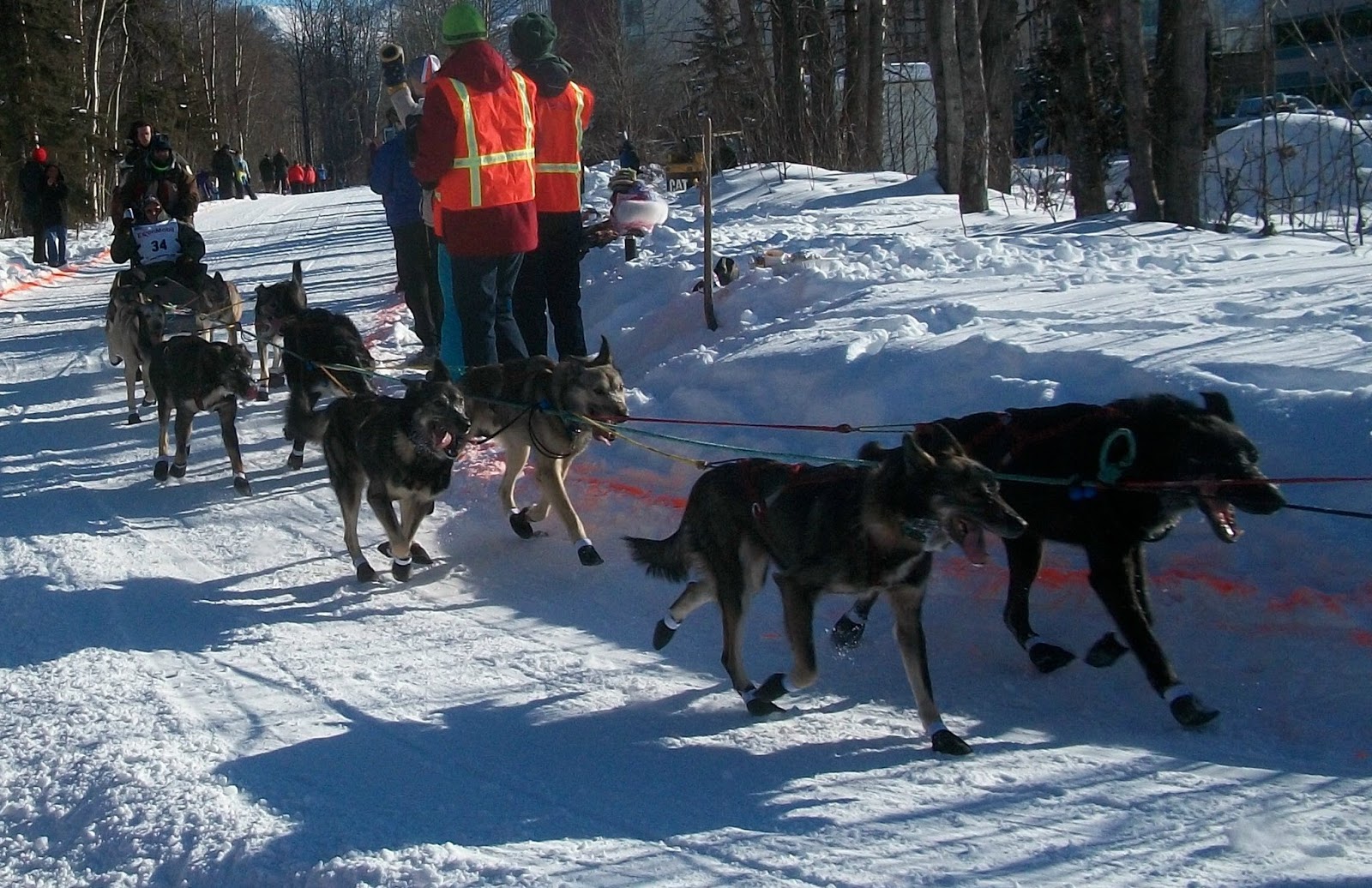
If you have seen one team go by you've seen them all?? Maybe to the jaded Anchorage residents but not to me. Every bunch of dogs looked a bit different and how they watched the spectators, took the sharp turn just past my vantage point and of course the mushers--their stance on the sled, their response to the crowds, and overall demeanor--there were no two alike. I just wish I could identify each and every team, but I can't. I'm not a pro photographer and my eyes were not the best that day so I felt lucky to get the level of shots I managed. I got the greater part of the women, pure luck! There was no way to quickly identify most of the mushers and teams. I could not always read the bib numbers, much less record them! So in some cases, my best guess--the numbers get fuzzy the longer you squint!

Bib 32 Hans Gatt

Bib 34 Jeff King

Bib 36, Allen Moore
(Mr. Aliy) SPK

Bib 37 Jessie Royer (5th w/ all16 dogs!)
Bib 52 Katherine Keith

Bib 56 Melissa Stewart (?)

Bib 58 Monica Zappa

Bib 73 Kristy Berington

Monday, April 10, 2017

At Tudor Crossing-Ceremonial Start

I want to get to some of the best parts! As I mentioned, I went along with some trail guards out to an area called Tudor Crossing. I took as many pictures as I could, trying to get every single musher. I did miss a few, some along in the 20s when I changed my vantage point and then three or four when the batteries suddenly failed in my camera--and of course one I missed was Aliy! Darn Murphy's Law!

I've gone through all of them and tried to enlarge to the point where I could read the bib number and identify the musher. For some it is impossible but I have positively identified quite a few. Those are some that I will share here.  The first shot is the area before the racers reached there and later I show the map that marks the route in Anchorage The rest are identified with bib number and/or name.

In most cases the mushers ran less than the full sixteen dogs. It is hard to control a very large team with the crowds, traffic etc so it is safer so most are running about a dozen. Also many use a second sled hitched behind the main one. Called a "tag sled" this also adds some drag, lets a handler or friend ride along and just allows a bit more fun.  All that is not done in the official race and there, most mushers start with the full sixteen dogs. You can drop one or more but not add any dogs once the race is underway. Cindy was one of the first I caught at the better vantage point, which is about where the trail appears in the  middle right of the other photographs. I will post some more on a separate entry shortly so I don't overload one section.

The diagonal line R toL is the trail.
Bib 31 Cindy Abbott (Red Ltrn)
Bib 20 Karin Hendrickson

Bib 15 Martin Buser(4 time champ)
Bib 16, Mitch Seavey ('17 winner) 
Deedee Jonrowe with her pink
Bib #22

Wednesday, March 29, 2017

Iditarod Volunteer Corps--Part 2


When I covered the volunteer subject in the previous post, I semi-intentionally left out one function. It will lead right into some of my experiences that were more closely linked to that area than the others. That final function is security. Volunteers working in this area do a wide range of things. They assist in guiding the musher parking in downtown Anchorage for the Ceremonial Start. Imagine lining up about seventy five dog trucks, some with trailers, so that each musher can proceed with his or her team to the starting line in an organized and orderly way. Yep, that is one big job.  Then the same work is repeated at the official start, be it at Willow, as usual, or in Fairbanks.

And, while the ceremonial start takes place and the ensuing run for eleven miles through the city and out to the BLM Compound on the northwest side, others serve for crowd control and make sure the snowy path stays clear and no one gets into a hazardous spot or distracts the dogs.  Once again they control the crowds as the official start gets underway.  Everyone wants to see it ‘up close’ and they jockey for the best photo op spots but spectators must not be allowed to interfere so volunteers man the barriers and keep people in a safe place. Volunteers  also assist at the Mushers’ Banquet—more on this shortly—and they keep watch on the dog yards, both that for dropped dogs returned to Anchorage and at the finish in Nome where dogs are housed for several days until all the mushers have arrived and the final awards ceremony is completed.  

Table decorations
One of the first jobs I had was working at the Mushers’ Banquet. This is a big event held in a huge hall in downtown Anchorage. At the event, fans and supporters can purchase tickets to dine and socialize with the mushers and watch the action as the mushers are called up in the order they registered for the race to draw their bib number which also determines their starting position. There is a big silent auction to raise added funds for the event and some volunteers help with this, using tablets to collect and record bids. Kids all around the country have made table decorations and long before the doors open volunteers put them, race guides and other documents out at each place—roughly 2,000 chairs in this enormous room, ten places at each of about 200 round tables. Every table had at least one item made by a school child somewhere in the US. Some were very creative and handsome, too!


Da'anina Center, Banquet site
Finally the doors opened and more volunteers stood in the portals and asked to see tickets of everyone who enters.. Most are orderly and polite but a few get pushy and have to be asked to stay out—or someone goes to find a supervisor and be sure the person is allowed to come in. I helped with both tasks and then got to observe the rest of the event. Unfortunately I was having a bad eye day and instead of wandering around to chat and get some photos as I had hoped, I watched the blurred action and mostly listened from the back of the room. Still, it was a thrill to be there. I heard Aliy speak after she drew her number—42—and thank the supporters for the love and good wishes they had poured out to her after the tragic snow machine issue last year. And I cheered for several other favorites.

This was Thursday evening, March 2. Two days later, I considered going to downtown Anchorage to watch the start –busses ran from the hotel and later brought people back--but instead opted to go out a bit farther with a group of the “Trail Guards” that included a new friend who had also volunteered at the banquet. 

At about 7:00 a.m. (still before daylight savings) it was c-o-l-d. The mercury hovered around the zero mark. Bare hands went red and then blue in mere minutes and you wanted a scarf or neck gaiter to cover your lower face! We took a cab out to the area known as Tudor crossing where the trail, normally a hiking and bike trail through some parks went in a tunnel under a busy road. We soon found the rest of the group who were mostly local residents. Everyone pitched in to help set up a big tent to give a warm-up place and to serve later for the tailgate party after the last team had passed. By then the sun came up and before long it was up in the twenties and did not feel bad at all.
Tudor Crossing trail guard gang


I found a couple of likely view points not far from the trail and set up with the goal of getting a photo of every team as it passed. I missed a few but got about sixty five of the seventy four or so that ran by. Besides the seventy three entered racers, the Honorary Musher—someone selected by the ITC Board each year for their support and contributions to the race-- led the way with a non-racing musher as their ‘taxi’.  I’ll be posting several of these photos in a later post.

After the final team had gone by—it took about three hours—we gathered for a great feed the local people provided. I had some ‘moose bratworst’ that was delicious and other more ordinary tailgate party treats. Finally my friend and I rode back with another volunteer who was in the same hotel we were—the Lakeside. It was a beautiful, sunny and mostly still day—what the Alaskans call a “Bluebird Day,” a real blessing and treat.  What a fabulous day that had been!!

My fave of the table decor!
Aliy via big screen video--know by red beanie
that it is her!!


Saturday, March 25, 2017

The Iditarod Voluteer Crops-Part 1

 It takes a virtual army of people with a variety of skills to support the massive endeavor that is the Iditarod Trail Sled Dog Race in the twenty-first century. When I arrived at the Lakefront Millennium Hotel on the south side of the city early in the morning on March 1, many people were there already. During the next two weeks, a conservative 2,000 people came and went, some heading home early, some out to the checkpoints, and some remaining long after I returned to New Mexico. They come from almost every state and a number of foreign countries. It seems very popular with Aussies and New Zealanders, Germans, some Japanese etc.
Lakefront Millennium Hotel

Here are a few of the special functions that must be performed:

  1. Veterinarians and Vet Techs. These folks have to examine and drug test every dog that goes out on the trail before the official start. Teams of them also go out to the checkpoints, sixteen in this year’s race route which ran from Fairbanks to Nome for the third time in the race’s forty-five year history. The normal official start is in Willow, just north of Wasilla and about sixty miles from Anchorage.  Then, as dogs are “dropped” which means taken off the musher’s teams, normally due to injury, sickness or just being overly tired, they are checked before they are transported by air back to Anchorage and after they arrive there.  The wellbeing of the dogs is very important to everyone involved and each year more advances are made in how they are managed and cared for.  More vets are at the finish at Nome to reexamine all dogs and ensure they are not in need of medical aid.

  1. Dog Handlers: This bunch has several jobs at different points in the race. For the ceremonial
    Hotel grounds, SW end
    start in Anchorage, which is the “show” part of the event, they assist the vets/techs and then help the mushers get the excited dogs lined out and kept under control until each team receives it’s “go” from the Race Marshall. They start at two minute intervals here just as they do in the second or official start.  Next, groups go out to the checkpoints where they assist the mushers by directing them to rest or parking places, locating drop bags (bags of food and supplies sent out ahead of time, each marked with the musher’s name) , watch and check on all dogs to include the dropped dogs before they are transported, help the vet with the examination of each dog and clean up the bedding straw and debris after each team departs.  They also monitor the dog yard at Nome while the mushers are busy with the festivities and public activities there, keep unauthorized people out and sometimes dispense food and water. Another group stays in Anchorage to pick up returned dogs at the airports and care for them until either the musher’s authorized representative can come to take them or for those not picked up with a few hours,  groups are taken to the Women’s Prison in Eagle River where inmates are privileged to care for them.

  1. Communications: This covers two broad functions, data collection and recording and answering incoming calls from the public.  Groups of comms folks go out to all checkpoints on the trail and with laptops and other electronic devices send back information on the arrival and departure times of each musher, number of dogs in and out for each team, monitor the mandatory rest times, and any other critical information. This data is received and compiled in Anchorage and entered into the data bases which generate the status reports given to the public and maintained for the entire period of the race.  Meanwhile, after the official start, people want to know who is ahead, where their favorite musher is and often seek to find out about rumors and ‘wild tales’ which do circulate. Information on such things is only given out after a press release is prepared but current standings can always be shared. This crew also sends out “Mushergrams” which are notes of support and encouragement sent to mushers by family, friends and fans. This function is not as busy as it was before the extensive use of the internet with videos and live streaming of portions of the action, but not everyone is on line, even today!
    Volunteer Registration  Room

Miscellaneous:  Other assorted tasks include packing materials to go to various checkpoints and in this instance to Fairbanks for the official start and Nome for the finish. All volunteers must register, receive a badge and the year’s cap, sign releases if they are not ITC members (that is not an official of the actual board but a ‘card carrying’ supporter, such as I am and most of the volunteers are.) In short the race headquarters is a busy place, even after the preliminary mushers’ meeting, the banquet where they draw start or bib numbers and get their dog ID tags and bibs etc. and the ceremonial start events.  A few also go out to some checkpoints to cook to feed the volunteers and mushers. Not until the last musher arrives in Nome, the last dropped dog is safely returned and the ‘loose ends’ of the rce are neatly tied up do the last volunteers depart.

Wednesday, March 22, 2017

The Miracles of Modern Travel


In a lot of ways I am awestruck by something we almost take for granted these days. It is almost too easy—you get on an airplane; it leaves the ground and soars hundreds of miles in a few hours to return to the earth and deposit its passengers to take another form of transportation to their destination or get on another plane to continue their journey.

For many years, the north forty-ninth state, which was not even a state when I was born, seemed incredibly distant to me and beyond reach. Then a dream and an idea began to take shape in my mind. In 2014, I discovered that by air, it is not so far at all—mere hours had me there.  Now I have been to Alaska and back five times and spent a total of close to three months there.  

Any long trip is an adventure. My latest was no exception. Although I am certainly not Catholic and really not even religious, I nearly feel I need to light a candle for St. Christopher, the patron of travelers. Either he or my guardian angel had to have been working overtime to ensure I made the trip as I had planned it and even my checked luggage did the same. It was by the narrowest of margins not once but twice!

On Tuesday, Feb 28, I boarded a ‘regional’ jet at El Paso, bound for Phoenix. Although the wind was blowing close to hurricane force gusts and moving clouds of dust, the plane took off without issues and landed safely in Phoenix at the appointed time. My gates were some distance apart as usual—switching from the short hop small planes to the larger long distance ones usually has the result.  I had more time than I expected because some issue –I think they said “a minor maintenance matter” kept us on the ground for quite while after the expected take off. Finally we were airborne, headed for SeaTac, the Seattle-Tacoma airport.

I was fretting about making a fairly close connection and expecting to have to take the tram from the “D” to the “N” concourse since I was switching from American to Alaskan. One of my seat companions was a younger business man who clearly traveled a lot. He had an app on his phone to look up gates and assured me we were to come in at D-11 and I would go out at D-3. What a bit of luck. Coming into the crowded airport, I checked the first board I saw and found that was true. I scurried and found the plane already in the boarding process but I was far from the last passenger. I did worry a bit whether my suitcase had made that flight, though. However I knew Alaskan is very good with luggage and would ensure I did get it.

Off we went to land about three and a half hours later in Anchorage. Lo and behold, my suitcase had indeed made it on the same plane and popped up quickly on the carousel. I grabbed it and went out in the chill to catch the shuttle to my hotel.

Two weeks later on March 14, I rode the same shuttle, emblazoned with a picture of sled dogs running in harness, since the hotel is the long-time headquarters for the Iditarod. At sundown the local temperature was about 10-15 (above zero!) but wind chill made it feel colder. I was early—I’d had to check out of my room at 12:00 noon and got tired of schlepping around the hotel. Now I just wanted to be home! The old hurry up and wait routine, too familiar!

I checked in, made it through security and found my gate. Still had time to burn so I visited a McDonald’s for a snack, wandered through some shops and finally it was time to board. We were about on time and landed in Seattle at 2:00 a.m. Again both gates were in “D” but the outbound was in a new area where the concessions had not even been opened yet and at that hour might not have been anyway. Oh well, I was then too tired and dull to want to eat. We were to leave at 5:00 and I would have an hour in Phoenix to get back to the puddle jumper gate.

The hour came and we were not boarding. The growing crowd was restive. Finally the representative told us they were missing two crew members, an officer and a flight attendant for whom substitutes had been summoned. We waited some more. It was right at 6:00 a.m., an hour late, when we took off. The pilot told us there was a headwind so he could not make up much time but he’d do his best to help all of us make any connections.
Just before take off I texted my brother and the friend who was picking me up that there might be a delay. An hour of my expected seventy-two minutes in Phoenix was gone…

When we touched down I had about forty minutes before the next plane was to leave. My set was back in row 21 and it took forever to get everyone on their feet, gear collected and moving. I tried not to get frantic. They had promised me an electric cart when I expressed concern at Seattle but someone lese must have nabbed it. With about twenty minutes left, I went to a customer service desk and got the gate number—the usual long run from the outer wing of “A” to the inner wing of “B”. I ran; even on the moving sidewalks, I ran, almost certain it was a lot cause but I had to try. Gate B-15 was obscure—I asked for it at B-16 and dashed back to find it hidden behind Starbucks. By then I was  shaking as I both cursed and blessed the fact more construction had these smaller planes out on the tarmac in the old fashioned way, though with a long ramp rather than stairs to climb aboard. I was the last passenger to get there.

I barely had time to text that I had made it and would be in El Paso at the appointed time. My hand shook so much I could hardly hit the letters.  I was and amazingly, my bag was too! Outside it was pushing 90 degrees. Even my flannel shirt was too hot and the mid-weight parka I had worn to the Ted Stevens Airport in Anchorage was a useless albatross. I shed both when we reached my friend’s SUV. He cranked up the air and two hours later I was home to be greeted by my eager red dogs. A journey of about fifteen hours total, from winter to summer, from Alaska to the Mexican Border, on which El Paso sits. From sled dogs to pet dogs and my own bed at last.


Yes, miracles on all sides. Heartfelt thank yous to whichever of the Powers-that-Be interceded for me.  Thanks also to the chap with the app between Phoenix nd Seattle and the two young men who shared my set from Seattle back to Phoenix and helped me slip on my backpack and blocked those behind so I could head down the aisle as soon as it was possible. Maybe looking like an old lady, especially a kind of eccentric ‘cowboy girl’ sort of one has its perks!